
Risk Is Not Price
A stock that just fell 15% can be the safest name on your screen. The one that didn’t move can be the most dangerous.

Risk Is Not Price
A stock that just fell 15% can be the safest name on your screen. The one that didn’t move can be the most dangerous.
Unstable Equilibria — June 2026
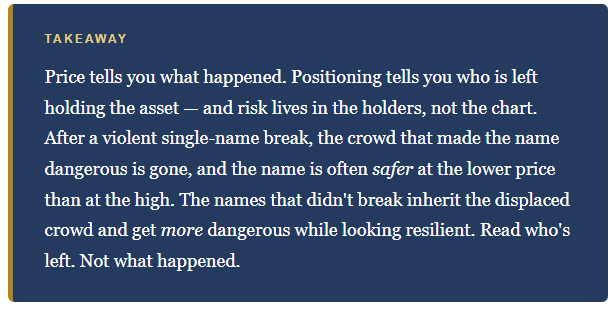
Two different things called “risk”
Price risk is what the chart shows: the asset fell, it’s volatile, it looks broken. A description of the past.
Positioning risk is who owns it: how concentrated, how recent, how correlated their exit would be. It never appears on a chart. It accumulates silently while the price does something reassuring — often because the inflows themselves are what’s suppressing the dips.
After certain events the two move in opposite directions. That divergence is one of the most exploitable misreading in markets, because everyone prices the first kind and almost no one prices the second.
Last week, in two charts
On June 4, Broadcom fell roughly 15% in a session after earnings that merely met expectations the crowd had already paid for. Micron fell almost 8% in sympathy. The Nasdaq-100 finished flat.
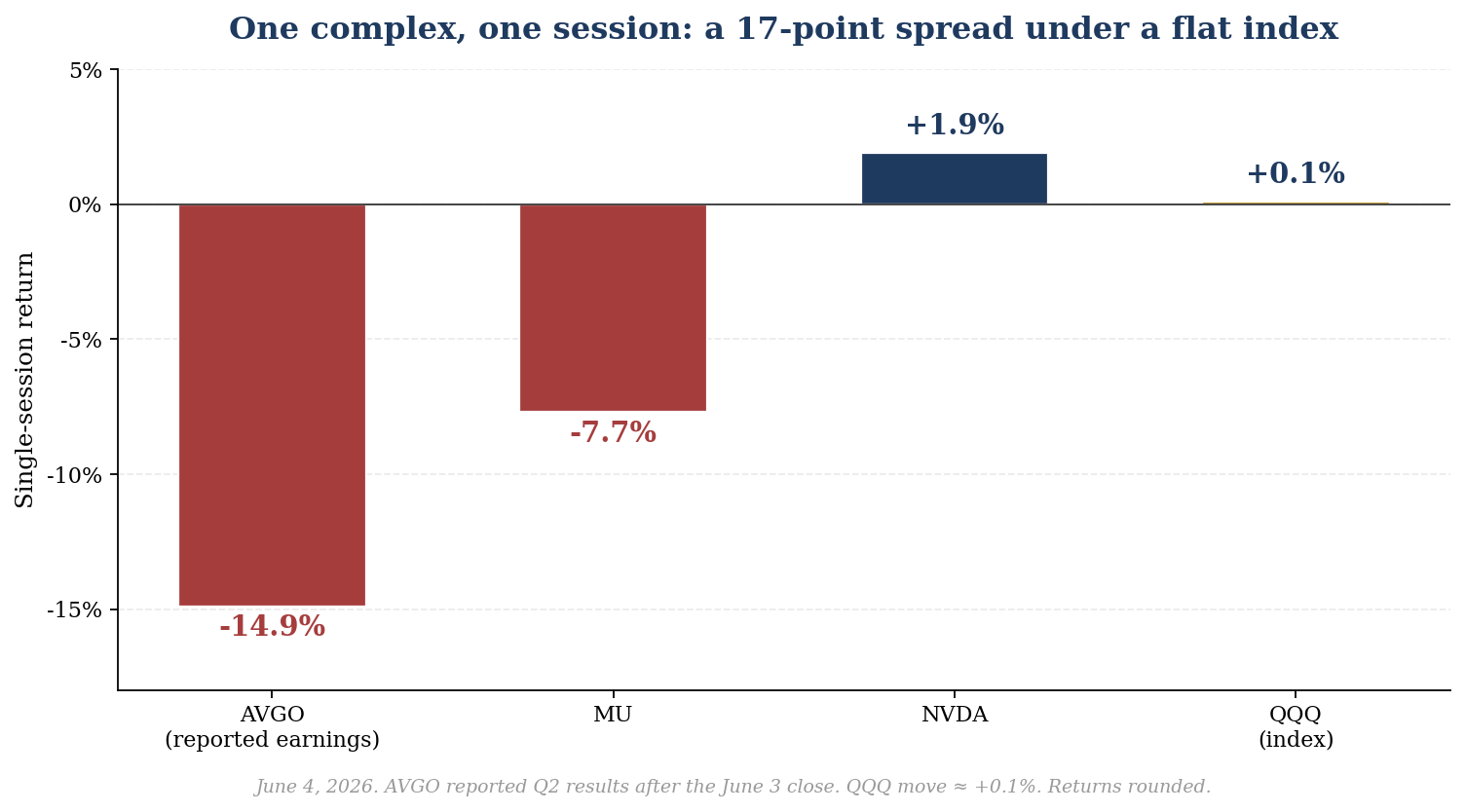
That’s the dispersion story — the index hid a 17-point single-day spread. The more interesting data arrived over the following week, in the positioning reads. Each week we compute a crowding z-score for every name we track: how extreme its positioning looks relative to all the others. Here is the complex, the week before the event versus the week after:
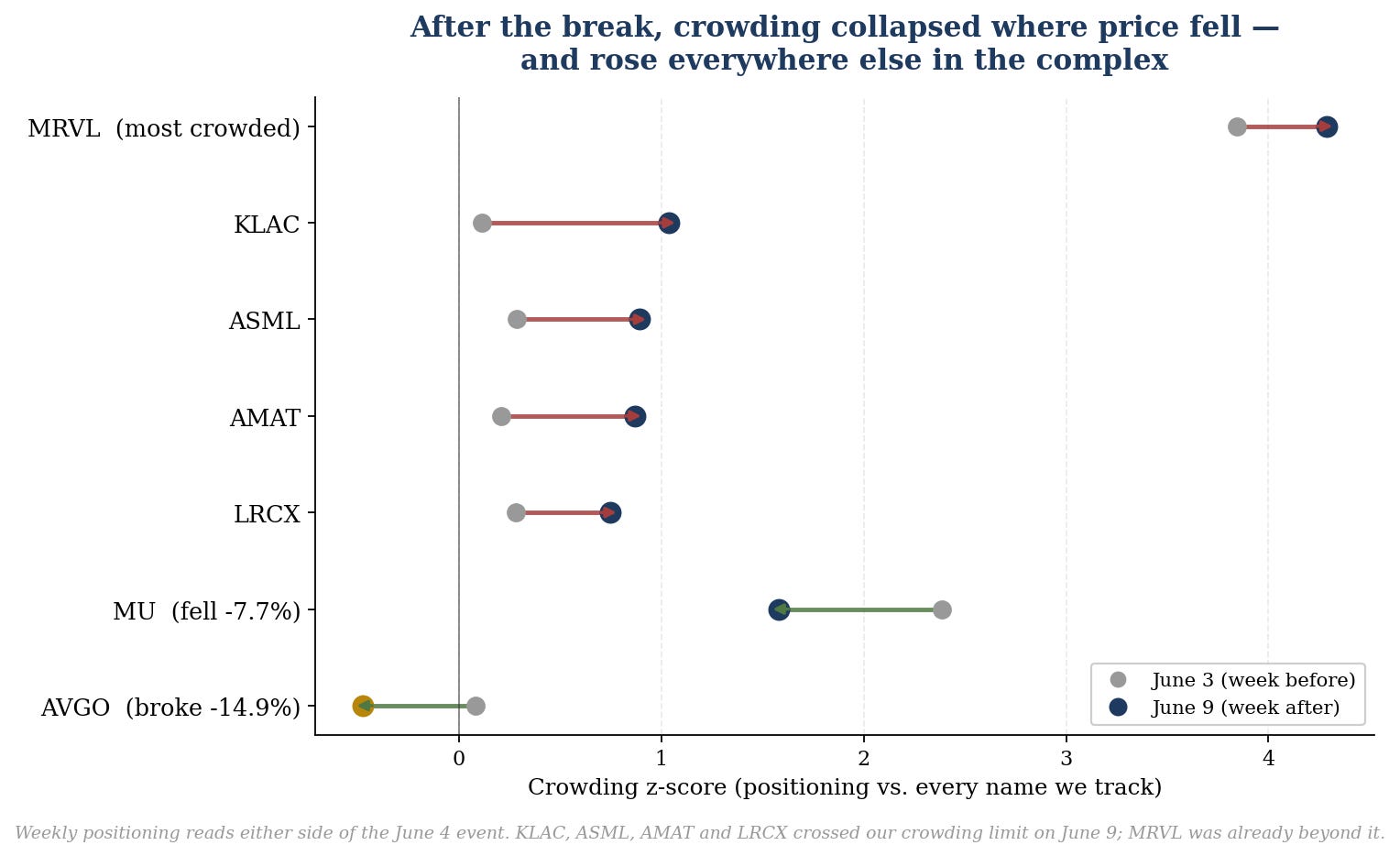
Three readings in that chart — plus one from the week before.
Going in, the map said the risk was next door. On June 3, AVGO’s crowding read was +0.08 — neutral, where it had sat for twelve straight weekly reads. It hadn’t registered a crowded reading all year. The extremes in the complex were MRVL at +3.85 and MU at +2.38 — both far enough out that they sat behind our crowding veto, the rule that bars us from holding any name whose positioning gets too extreme. We owned neither. The price map said AVGO was the beloved one. The positioning map said the loaded ones were its neighbors.
The break made AVGO cleaner, not more dangerous. Crowding fell to -0.47, comfortably below any veto threshold. Down 15% on the week, AVGO now carries the cleanest positioning reading in the complex. We held our long through the break — a hit of roughly 0.4% at the portfolio level — and the post-event readings improved. We kept the position.
The survivors inherited the crowd. MRVL, KLAC, ASML, AMAT, LRCX all saw crowding rise. MRVL — already the extreme — went to +4.29, the most extreme reading across every name we track. Four of the five crossed the veto threshold on June 9, and we exited all four the same day. (The one exception in the complex: NVDA, which rallied that day, saw its read ease — the crowding concentrated in the names tied to the disappointment, custom silicon and semi cap
equipment, not in the perceived safe haven.) The displaced capital didn’t leave the theme. It compressed into the names closest to the break.
So is the takeaway “buy the dip”? That’s the price-map question, and it’s the lesser half. The positioning answer has two sides: the broken name is the one place in the complex where the crowd has already left (we stayed long), and the resilient names are where it now sits (we exited four, and the veto still bars the other two). A crowding measure won’t tell you which name breaks. It tells you where the displaced crowd lands — and that is where the next break comes from.
The mechanism
The sequence repeats every earnings season. A crowd accumulates in a name; an increasing share of the holder base arrived recently, at high prices, for the same reason, with the same exit trigger. Then a catalyst lands that fails to exceed what crowded money already paid for, and the recent arrivals all use the exit they all share. One session, double-digit gap.
Now ask the question almost nobody asks: who is left? The holders who didn’t sell into the gap — longer tenure, lower cost basis, slower triggers. The fragile layer of the ownership has been stripped off in a day.
And the crowd that exited didn’t leave the market. Capital that abandons one expression of a theme migrates to the nearest expressions that didn’t break — making them more concentrated, more recent, more unified around one narrative (”this is the safe one”). The event that cleans out one name loads the gun on its neighbors. That is why the first casualty of a crowded theme is rarely the last.
Two dips that look identical
Two names, both down hard. Same magnitude, same speed.
Dip one comes with a crowding flush: positioning collapses from extreme to neutral, the recent-money cohort exits. The decline was the unwind. The structural sellers are spent.
Dip two comes with positioning still elevated after the fall: the crowd is intact, merely bruised. The decline was a warning shot, not a discharge. The structural selling hasn’t happened yet.
On a chart, indistinguishable. In positioning data, opposites. “Buy the dip” and “never catch a falling knife” are both half-truths waiting for this distinction.
The pattern in the wild
February 2018. Inverse-volatility products had printed years of smooth gains — the calmest charts on any screen — while short volatility became one of the most crowded trades in the market. When volatility jumped, the flagship product lost over 90% overnight and was terminated. Calm chart, loaded ownership.
August 2007. Quantitative funds running similar factor models lost double digits in days — some a quarter of their value — while headline indices registered an unremarkable stretch. Crowding as a basket property, invisible at index level.
2021–2022. A flagship innovation fund declined more than 75% peak-to-trough — while attracting net inflows through over a year of falling prices. The crowd never left, so the decline never finished. Dip two, in its purest recorded form.
August 2024. A rate surprise unwound a globally crowded carry trade: Japan’s main index fell 12% in a session — its worst day since 1987 — and volatility spiked above 60. Within weeks most of the damage was repaired, because speculative positioning had flipped from record one-sided to flat within a month. The crowd was gone, so the selling was done. Dip one, at global scale.
What to read
Three questions, none requiring private data:
How concentrated and recent is the ownership? Cross-sectional positioning measures — flows, short interest, options skew (the premium paid for downside protection), crowding z-scores — locate each name against its peers. Extremes mark where exits would be correlated.
What did the event do to positioning, not price? A big move with a positioning flush is a discharge. A big move with no positioning change is a tremor before one.
Where did the displaced crowd go? After every break, scan the same theme’s survivors. Resilience on unwind day is not a safety signal. It is frequently a destination signal.
The closing point
Risk is a property of the holder distribution, not the price path. Two assets with identical charts carry entirely different risk if one is held by patient, dispersed, low-cost-basis owners and the other by a concentrated, recent, single-trigger crowd. The price path is one realization of history; the holder distribution generates the next one. When they disagree, the generator wins — with a lag. The lag is the opportunity.
The asset that just fell is not the asset that just got riskier. Often it is the asset that just got rid of its risk. The danger didn’t vanish — it moved next door, where the chart still looks fine.
Price risk is the record. Positioning risk is the forecast. The market quotes the first and conceals the second — which is precisely why the second pays.
Thresher Fixed LLC. This is not investment advice. Not a recommendation to buy or sell any security. Past performance is not indicative of future results.