
Model Note

Our Models Went Long Oil on January 21st
Thresher Fixed LLC · March 2026


Nine weeks ago, our framework flipped to long on crude oil. +75% later, it hasn’t looked back. Here’s what we saw and why we acted when we did.
The Two Signals
Regime Signal is the slow one. It looks at the long-term shape of an asset’s price history and asks a single question: has the structure held long enough to trust? It doesn’t move on a single bad week or a single strong rally — it waits until the weight of evidence is overwhelming. One pattern it picks up particularly well is volatility clustering: the tendency of markets to grind sideways in compressed ranges for extended periods, then break decisively. That quiet drift is not randomness; it’s structure accumulating. Regime Signal reads the accumulation.
Coherence Signal is faster. It measures whether an asset is moving in the same direction across short, medium, and longer time horizons at the same time. One time horizon trending is noise. All three aligned is a signal. When they diverge, it does nothing.
Both must agree before we put on a position. One signal alone isn’t enough — that design choice alone keeps the book out of most false starts.
What Happened in January
Oil had been drifting lower since mid-2025, and both signals were negative through the end of the year. Nothing unusual. The model was correctly flat while crude was going nowhere useful.
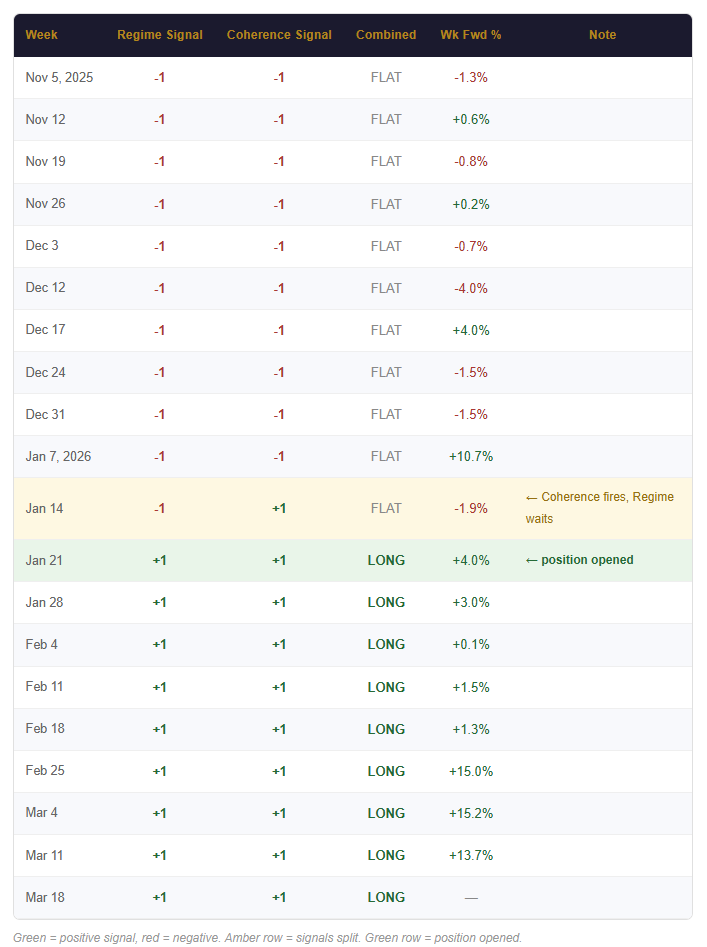
January 14th: Coherence Signal saw alignment across timeframes and flipped long. Regime Signal was still negative. Combined reading: flat. No position.
January 21st: Regime Signal caught up. Both long simultaneously. Position opened. Nine weeks later, neither has moved.
The Vol Compression Before the Break
The setup coming into January had one feature worth calling out. Crude had been unusually quiet for months — the kind of quiet that doesn’t feel significant in the moment but shows up clearly in hindsight.
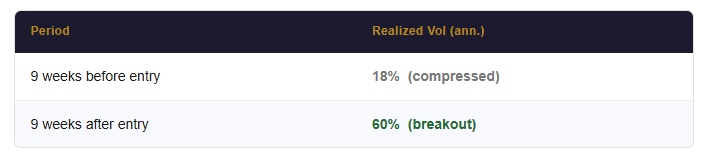
Volatility at 18% annualized is historically low for a commodity that typically runs twice that. That compression is exactly what Regime Signal is designed to read — not a trendless market, but a market coiling. When it broke in late January, it broke hard: 60% realized vol over the following nine weeks, more than three times the pre-entry level. Regime Signal saw the end of the calm coming. Coherence Signal confirmed which way.
Why Oil, Why Now
The signals don’t explain themselves — they read price. But the conditions underneath were visible enough once the break happened. China’s stimulus was finally feeding through into industrial demand. The dollar had stopped going up. And Middle Eastern risk — Iran’s posture in the Strait, ongoing Houthi activity in the Red Sea — was starting to build a genuine risk premium into the forward curve in a way it hadn’t been before.
We don’t trade headlines. But headlines change price structure, and price structure is what we read.
Copper, for Contrast
Copper was long alongside oil all through this period — both signals positive, full allocation. This week Regime Signal flipped negative on copper while Coherence Signal held. The combined reading went to flat. Position closed.
That exit is not a view on China or tariffs. It’s Regime Signal telling us the longer-arc structure in copper has shifted. We don’t argue with it. Oil shows no equivalent deterioration — both signals remain firmly positive, and the position stays.
What Closes the Trade
For the position to close, one of the two signals needs to flip negative. Regime Signal typically moves after a sustained multi-week reversal disrupts the longer-term trend. Coherence Signal moves faster — it breaks when the short and medium-term picture starts pulling in different directions.
Neither is close based on current data. Crude at 60% annualized vol can move quickly, and we’re watching both signals every week. Any change will be reported here as soon as it appears.
Thresher Fixed LLC. This is not investment advice.